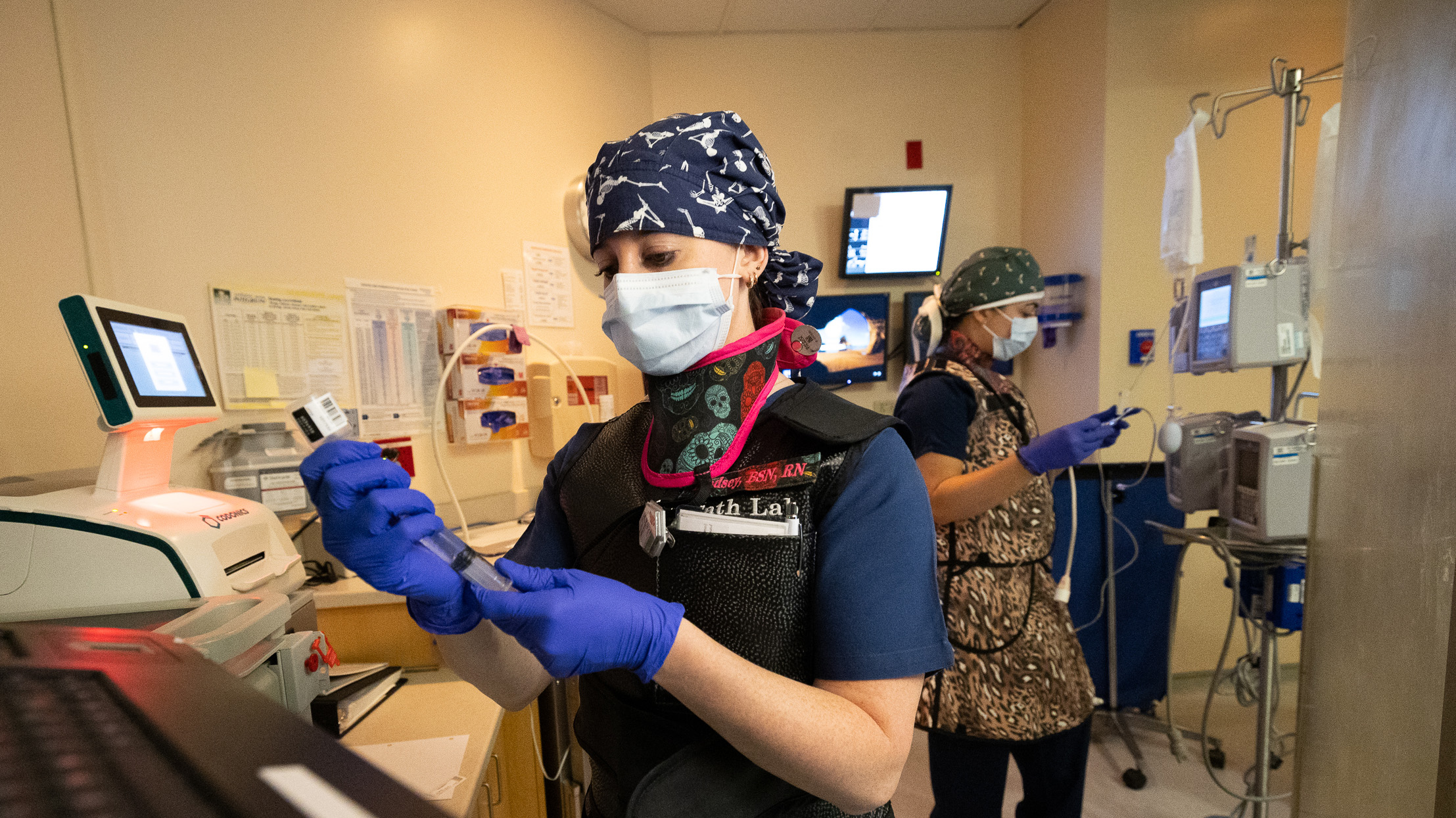
Exeter's Cardiac Cath Lab
Care That Can’t Wait
Expanding lifesaving cardiology services closer to home
Chad Dixon never imagined he was having a heart attack. In his mid-50s, he led a healthy lifestyle and had no family history of heart disease, so when he felt pain in his neck and shoulders one morning, a cardiac emergency was the last thing on his mind. But when dizziness set in and he briefly lost consciousness, everything changed. Chad’s wife Ewa rushed him to the emergency department at nearby Exeter Hospital, where doctors and nurses sprang into action. It turned out Chad was having a severe heart attack, with an 80 percent blockage in one of his arteries.
In moments like these, timely intervention is lifesaving. Access to high-quality cardiology care right in the Exeter community is not just a convenience; it is critical. Investments in local cardiology services ensure that people like Chad can receive expert care when every second counts, profoundly impacting not only patients, but their families as well. As part of its commitment to providing compassionate, accessible care, Exeter is therefore working to elevate and expand these vital services.
[QUOTE_HERE]
For Chad, immediate treatment was crucial. He was promptly taken to the cardiac catheterization (or “cath”) lab, where two stents were placed to restore blood flow to his heart. The cath lab provides access to minimally invasive diagnostic tests and treatments for cardiovascular diseases without surgery. Because his care team moved quickly and had the resources they needed, Chad not only survived but avoided long-term damage to his heart. “I’m here because time matters,” he reflects. “If Exeter hadn’t had a cath lab and the team ready to care for me that morning, I wouldn’t be alive. I’m sure of it.”
Chad’s story is a powerful example of the profound impact that local cardiology services can make, and it is support from the community that makes positive outcomes like his possible. The Exeter team is deeply grateful to those who have invested in the hospital’s cardiology expansion efforts, including the William H. Donner Foundation, Newburyport Bank, and the Katy and Steve Singlar Family Charitable Fund. Their generosity, along with support from others, will enable Exeter to upgrade its computed tomography (CT) and magnetic resonance imaging (MRI) capabilities—critical tools that allow clinicians to diagnose heart disease earlier, with greater precision. The hospital will also be able to expand its cardiology footprint to include a second cath lab—like the one that saved Chad’s life—and electrophysiology (EP) services.
“Investing in state-of-the-art technology and expanding our services will not only improve the treatment experience for our patients and dedicated clinical teams—it will save lives,” says Exeter cardiologist Gregory Goodkin, MD, FACC. Goodkin worked closely with Thomas P. Wharton Jr., MD, a leading cardiologist at Exeter and pioneer in advancing non-surgical interventions in community settings. Wharton passed in 2017, but his legacy lives on at Exeter and beyond. Goodkin sees the expansion of the hospital’s cardiology services as a meaningful way to build on his colleagues’ trailblazing efforts. “It is so important to carry Dr. Wharton’s work forward. He believed deeply in making care available when and where it is needed most, and with the support of the community, we can continue to realize his vision.”
Make a gift toward the expansion of Exeter’s cardiology services. Select Campus Transformation and Innovation Fund from the dropdown menu.